
What you need to know now about the cost to build a house in Maryland:
-
The Bottom Line: In 2026, the real cost to build a custom home in Maryland spans from $250 to $450+ per square foot, meaning a standard 2,500-square-foot build requires a baseline construction investment of $625,000 to $1,125,000+, completely excluding the price of land.
-
The Location Premium: High-demand jurisdictions like Montgomery and Howard Counties routinely command the highest rates, with projects frequently pushing past $350–$400 per square foot due to expensive labor and glacial, complex permitting processes.
-
The Performance Factor: Real value isn’t found in cheap, code-minimum framing; investing early in advanced building science, superior insulation, and tight thermal envelopes significantly lowers your monthly operational costs and keeps the home comfortable for decades.
A mid-range custom home in Montgomery County with thoughtful energy efficiency features will land closer to $350-$400 per square foot. That same house built as basic builder-grade in a rural county drops to $250-$275 per square foot. The gap comes down to labor availability, permitting complexity, and what you’re actually building.
Read on to map out your pre-construction budget and discover exactly where local site fees hide before you break ground.
What Does It Actually Cost to Build a House in Maryland?
The cost to build a house in Maryland in 2026 ranges from $500,000 to over $1,000,000 for a complete project, depending on size, finishes, and location. This includes construction but excludes land purchase, which can add $100,000 to $500,000+ depending on the county. Montgomery County, Howard County, and Anne Arundel County command premium pricing due to higher labor costs and stricter permitting requirements.
Here’s what matters more than the averages: Maryland spans wildly different construction environments.
Building in Garrett County is not the same as building in Bethesda. The labor pool is different. The permit process is different. The expectations around energy performance and stormwater management are different.
According to the Maryland Department of Assessments and Taxation’s 2026 Residential Cost Rates, county-level cost indices vary by more than 20% across the state. Montgomery County carries one of the highest multipliers in the state, reflecting the reality that trades are in high demand and permitting takes longer.
We’ve built across the DC metro for years. The difference between a $300/sq ft build and a $400/sq ft build isn’t usually the finishes. It’s how much building science you layer in, how complex your mechanical systems are, and whether your builder knows how to navigate Montgomery County’s strict energy codes without burning schedule.
National Context: How Maryland Compares
Maryland’s construction costs sit above the national average.
The National Association of Home Builders reported in their 2024 Construction Cost Survey that construction costs now represent 64.4% of a new home’s sales price, the highest share since they started tracking in 1998. That percentage increased from 60.8% in 2022, driven largely by building material inflation.
The gap isn’t arbitrary. It reflects real constraints: a tight labor market, stringent stormwater and Chesapeake Bay regulations, and jurisdictions that expect homes to perform better than minimum code.
Building in Maryland means navigating some of the country’s most complex permitting and environmental requirements. We help clients understand these costs upfront so there are no surprises when you break ground. Explore Our Process →
How Much Does It Cost Per Square Foot to Build a House in Maryland?
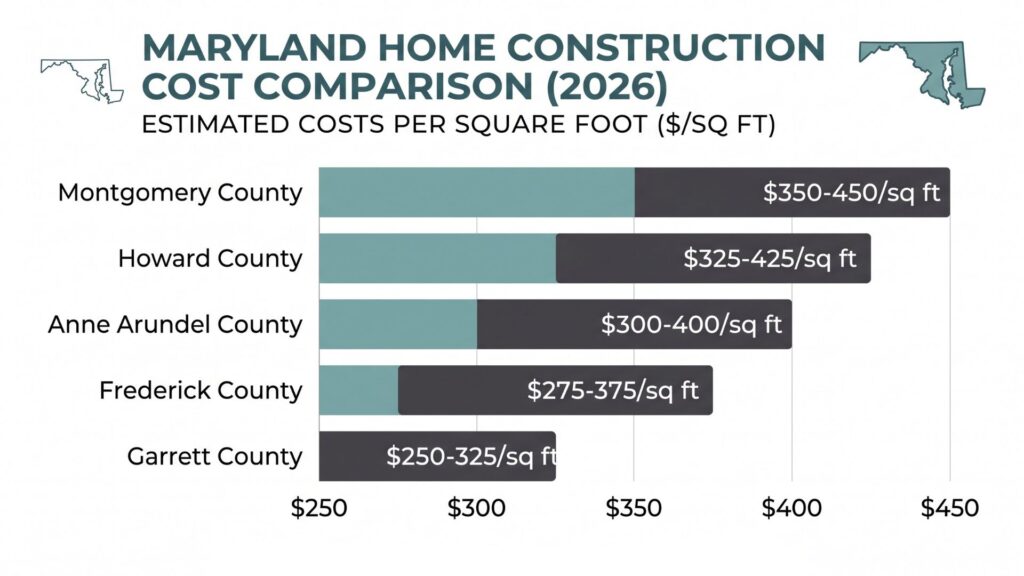
The cost per square foot to build a house in Maryland ranges from $250 for basic builder-grade homes to $450+ for luxury custom builds in 2026. Mid-range custom homes with upgraded finishes and energy-efficient features typically cost $300-$375 per square foot. The per-square-foot cost decreases slightly as home size increases, but quality tier and location have far more impact than square footage alone.
Breaking it down by tier helps, but keep in mind these aren’t neat categories. Most custom homes blend elements from multiple tiers depending on where the client wants to invest.
Basic Builder-Grade ($250-$275/sq ft)
This is production-level construction. Efficient floor plans, standard materials, code-minimum insulation and mechanical systems. You meet Maryland building codes but you’re not exceeding them. These homes work fine if your priority is getting square footage at the lowest possible cost.
The trade-off shows up in utility bills and long-term maintenance. Code-minimum insulation means higher heating and cooling costs. Standard HVAC sizing without load calculations means rooms that don’t stay comfortable. It’s not bad construction, it’s just optimized for first cost, not lifecycle cost.
Mid-Range Custom ($300-$375/sq ft)
This is where most of our clients land. You get flexibility in layout, better finishes, custom millwork, and the ability to incorporate real building science without blowing the budget.
At this tier, you can afford to tighten the thermal envelope, add ERV ventilation, and use high-performance windows. You’re not chasing net-zero, but you’re building a home that will cost 20-30% less to heat and cool than a code-minimum house.
The finishes step up: quartz counters instead of laminate, hardwood or luxury vinyl instead of builder-grade carpet, tile showers with decent fixtures. The cabinets are still semi-custom, but you’re picking from real options, not just white or off-white.
We’ve seen clients at this tier who prioritize building science over finish upgrades. They’ll take a simpler kitchen to afford spray foam and triple-pane windows. That decision pays dividends every winter.
Premium/Luxury Custom ($400-$550+/sq ft)
This is where budgets open up enough to do both: high-performance building science and luxury finishes.
We’re talking walls detailed for air sealing, advanced framing techniques, geothermal or high-efficiency heat pumps, and a real focus on indoor air quality. The mechanical systems get designed, not just sized from a table. The windows are European-grade. The insulation strategy is intentional.
On the finish side, you’re looking at custom cabinetry, stone counters, high-end tile, premium fixtures, built-ins, and architectural details that take time to execute. These homes often include complex rooflines, extensive millwork, and features like wine cellars or home theaters that require specialist trades.
Waterfront properties in areas like Annapolis or the Eastern Shore, and high-end builds in Potomac or Bethesda, regularly push past $500/sq ft when you factor in site challenges and client expectations around finishes.
What Factors Affect the Cost to Build a Custom Home in Maryland?
Several factors affect the cost to build a custom home in Maryland: location and county permitting requirements, lot conditions and site preparation needs, home size and complexity, quality of materials and finishes, energy efficiency and building science features, and current labor and material costs. Montgomery County and Howard County have higher permitting fees and stricter zoning requirements than rural counties, while challenging lots with poor soil, steep slopes, or limited utility access can add $50,000-$150,000+ to project costs.
Let’s walk through what actually moves the number.
Location: County-Level Cost Differences
Where you build in Maryland determines your baseline cost before you pick a single finish.
Montgomery County, Howard County, and Anne Arundel County sit at the top of the cost curve. Permitting fees run higher. Zoning and environmental reviews take longer. Trades are in demand and price accordingly. If you’re building in Bethesda or Columbia, you’re competing with dozens of other projects for the same pool of skilled subcontractors.
The flip side: rural counties like Carroll, Frederick, or Worcester offer lower permit fees and less competitive labor markets. The per-square-foot cost drops, but you trade that for longer lead times on materials and potentially limited access to specialized trades.
Chesapeake Bay Critical Area designations and stormwater management requirements add cost regardless of county, but they hit harder in Anne Arundel and the Eastern Shore where environmental scrutiny is tightest.
Lot and Site Conditions
A flat, cleared lot with municipal water, sewer, and power at the street is the baseline scenario. Everything that deviates from that adds cost.
Clearing and grading a wooded lot: $15,000-$40,000 depending on tree density and how much you’re moving around. Steep slopes cost more because you’re either cutting into the hillside or building retaining walls.
Well and septic systems add $25,000-$50,000 if you’re in a rural area without public utilities. Bringing power or water lines more than a few hundred feet gets expensive fast.
Poor soil conditions are the wildcard. If your geotechnical report comes back showing you need deeper footings, engineered fill, or other foundation work, that can add $30,000-$100,000+ to the budget. There’s no way to predict it without soil testing, which is why we always recommend a geotech survey before you buy land.
Home Size and Complexity
Bigger homes cost more in absolute dollars, but the per-square-foot cost often drops slightly as you scale up. Fixed costs like permitting, design fees, and site work get spread across more square footage.
Complexity matters more than size. A 3,000-square-foot box with a simple roofline costs less per square foot than a 2,500-square-foot home with multiple gables, a complex foundation, and three different ceiling heights.
Every interior corner, every roof valley, every floor-level change adds labor and material. Simple geometry keeps costs down. That doesn’t mean your home has to look like a barn, but thoughtful design can save tens of thousands without sacrificing aesthetics.
Material and Finish Selections
This is where budgets get personal. Two homes with identical floor plans can differ by $150,000 based purely on finishes.
Standard finishes (laminate counters, vinyl flooring, builder-grade cabinets, fiberglass tubs): baseline cost already baked into the $250-$275/sq ft range.
Mid-grade finishes (quartz counters, hardwood or luxury vinyl, semi-custom cabinets, tile showers): add $30-$60/sq ft to your baseline.
Premium finishes (natural stone, custom cabinetry, high-end tile, specialty fixtures): add $80-$150+/sq ft.
The finish budget is where clients have the most control. You can always upgrade counters or cabinets later. You can’t easily upgrade the thermal envelope or mechanical systems once drywall is up.
Energy Efficiency and Building Science
This is the area where we see clients make choices that affect the next 30 years of ownership.
Code-minimum construction in Maryland meets 2021 IECC standards with some state amendments. It’s adequate. But adequate means you’re heating and cooling a house that’s leakier than it needs to be, with insulation levels that were considered acceptable a decade ago.
Adding performance costs upfront but saves long-term:
Tightening the air barrier and adding continuous exterior insulation: $8,000-$15,000 on a typical home. This pays back in 5-8 years through lower utility bills.
High-performance windows (triple-pane or high-quality double-pane with low U-factors): $5,000-$12,000 over standard windows. Comfort improvement is immediate. You stop feeling cold near windows in winter.
Advanced HVAC (properly sized heat pump, ERV ventilation, ductless mini-splits in bonus spaces): $8,000-$20,000 over a standard system. Better comfort, better indoor air quality, lower operating costs.
These upgrades push you from the $300/sq ft range toward $350-$375/sq ft, but you’re building a house that costs less to own and feels better to live in. We walk every client through this trade-off because it’s one of the most important decisions you’ll make.
Most builders optimize for first cost. We optimize for lifecycle value. Our homes incorporate building science that reduces energy costs by 25-40% compared to code-minimum construction. Learn About Our Custom Home Process →
Current Material and Labor Costs
Construction costs don’t sit still. Material prices have increased 41.6% since 2020 according to NAHB data, outpacing overall inflation. Lumber, steel, and concrete all saw significant price increases, with some materials stabilizing in 2024-2025 but remaining well above pre-pandemic levels.
Labor availability remains tight across Maryland. The construction industry reported nearly 300,000 job openings nationwide in December 2025 according to NAHB’s 2026 Housing Outlook. That shortage puts upward pressure on wages, which shows up in your bid.
In Montgomery County specifically, we’re seeing 8-12 week lead times on certain trades during peak season. That delay risk is real and needs to factor into your timeline and budget.
How Much Does Land Cost in Maryland?
Land costs in Maryland range from $50,000 to $500,000+ depending on location, lot size, and development status. Rural lots in Western or Eastern Maryland start around $50,000-$100,000 for 1-2 acres, while buildable lots in Montgomery County, Howard County, or Anne Arundel County typically cost $200,000-$500,000+. Finished lots with utilities already run to the property command premium pricing but eliminate site preparation uncertainty and costs.
Location drives everything with land pricing, just like it does with construction costs.
Montgomery County buildable lots start around $250,000 and climb quickly from there depending on neighborhood and lot size. Potomac and Bethesda lots in established areas easily hit $400,000-$600,000+ for a half-acre to one-acre parcel.
Howard County (Columbia, Ellicott City) runs similar, with lots in desirable school districts commanding $200,000-$400,000.
Anne Arundel County near Annapolis sees $150,000-$350,000 for buildable lots, with waterfront parcels significantly higher.
Frederick County, Carroll County, and other areas west of Montgomery County offer better land values at $75,000-$200,000 for 1-3 acre parcels.
Raw land versus improved lots matters. An improved lot has utilities stubbed to the property line, perc testing done, and often preliminary engineering completed. You’re paying a premium for that, but you’re eliminating unknowns. Raw land is cheaper upfront but comes with risk: soil conditions, septic approval, utility extension costs.
The hidden costs in land acquisition: title work, surveys, soil testing, environmental assessments, and carrying costs if you’re financing. Budget another $10,000-$20,000 for due diligence and closing costs on land purchases.
What Are the Soft Costs in Building a Maryland Home?
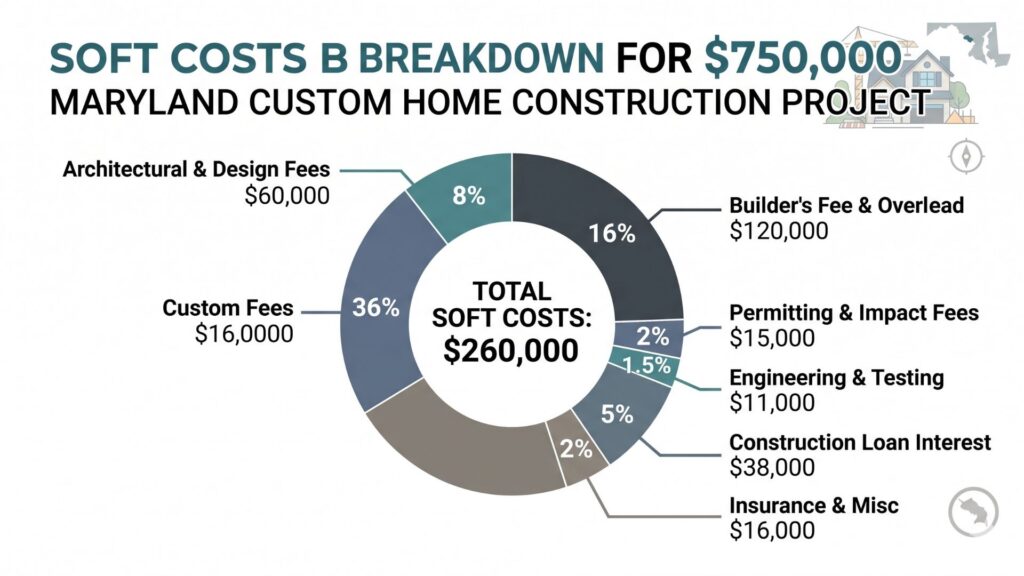
Soft costs in building a Maryland home include:
- architectural and design fees (5-15% of construction costs),
- permitting and impact fees ($5,000-$60,000+),
- engineering costs ($5,000-$15,000),
- survey and soil testing ($3,000-$8,000),
- builder’s fee and overhead (15-20% of construction costs),
- insurance during construction ($2,000-$5,000),
- financing costs if using a construction loan.
For a $750,000 construction budget, expect $150,000-$200,000 in soft costs, pushing total project cost to $900,000-$950,000 before land.
These numbers surprise people who focus only on the construction contract. The soft costs add up fast and they’re largely unavoidable.
Architectural and Design Fees
Full custom design from an architect runs 8-15% of construction cost. For a $750,000 build, that’s $60,000-$112,500.
If you’re working with a design-build firm or using a builder’s in-house designer with modifications to existing plans, fees drop to 5-8% or sometimes a flat fee of $20,000-$50,000 depending on complexity.
Stock plans with minor modifications cost less, typically $5,000-$15,000, but you lose flexibility and the design may not optimize for your specific lot or lifestyle.
We at Ambition Custom Homes include design coordination in our process because it catches problems on paper instead of in the field. Changes on a drawing cost nothing. Changes after framing starts cost thousands.
Permitting and Impact Fees
Montgomery County building permits alone run $8,000-$15,000 for a typical single-family home depending on square footage and project value. Impact fees for schools, roads, and utilities add another $5,000-$15,000+ depending on the jurisdiction.
Howard County and Anne Arundel County run similar, while rural counties often charge less than half that amount.
If you’re in a Chesapeake Bay Critical Area or need stormwater management plan approval, add another $3,000-$8,000 for engineering and permit review.
Historic districts, HOA architectural review, and other overlay requirements can add weeks to months to your approval timeline and additional fees.
Engineering and Testing
- Structural engineering for custom elements (complex roofs, large spans, basement walls): $5,000-$10,000.
- Geotechnical survey and soil testing: $2,000-$5,000. Not optional if you want to avoid foundation surprises.
- Survey and plot plan: $1,500-$3,000.
- Energy modeling if you’re pursuing a specific performance target: $1,500-$3,000.
Builder’s Fee and Project Management
General contractors in Maryland typically structure fees as 15-20% of hard construction costs. That percentage covers overhead, project management, insurance, warranty, and profit.
For a $600,000 construction cost, you’re looking at $90,000-$120,000 in builder’s fee. That’s not padding, that’s what it costs to run a business that carries insurance, manages subcontractors, handles inspections, and stands behind the work for years after you move in.
Some builders break this out explicitly, others roll it into their pricing. Either way, it’s there.
Construction Loan Interest
If you’re financing construction, expect to pay interest-only during the build. On a $600,000 construction loan at 8% for 10 months, you’re paying roughly $40,000 in interest before you convert to a permanent mortgage.
Loan fees, appraisal, and closing costs add another $5,000-$10,000.
Insurance During Construction
Builder’s risk insurance covers the structure during construction. Cost varies by project value but typically runs $2,000-$5,000 for a single-family home.
You’ll also need liability coverage if you’re acting as owner-builder, though most people building custom homes work with a licensed contractor who carries this.
Understanding the full cost picture before you start is critical. We provide detailed line-item budgets that break out soft costs, construction costs, and allowances so you know exactly where your money goes. See How Our Process Works →
How Much Does It Cost to Build a House in Montgomery County, MD?
Building a house in Montgomery County costs $350-$450+ per square foot in 2026, making it one of Maryland’s most expensive counties for new construction. A 2,500-square-foot custom home runs $875,000-$1,125,000+ before land, soft costs, or site work. Higher costs reflect Montgomery County’s strict permitting requirements, competitive labor market, environmental regulations, and client expectations for quality and energy performance.
Montgomery County sits at the top of the Maryland cost curve for good reasons.
Permitting is slower and more rigorous than anywhere else in the state. Building permit review takes 8-12 weeks minimum, often longer if you trigger additional review for stormwater, forest conservation, or historic district compliance.
Impact fees and permitting costs run higher than surrounding counties. Expect $15,000-$60,000+ in permit and impact fees alone before you pour a footer.
The labor market is tight. Every custom builder in Bethesda, Potomac, Rockville, and Chevy Chase is pulling from the same pool of subcontractors. Trades know they can be selective about which jobs they take, and they price accordingly.
Environmental requirements add cost and complexity. If you’re near a stream, in a Chesapeake Bay Critical Area, or dealing with steep slopes, expect additional engineering and stormwater management costs that wouldn’t apply in less regulated counties.
The upside: Montgomery County’s building department and inspection process is thorough. They catch problems. They enforce code. When you get your certificate of occupancy, you know the house was built right.
Client expectations run higher here too. People building in Potomac or Bethesda aren’t looking for builder-grade finishes. They expect custom millwork, high-end appliances, and performance features like whole-home automation and advanced HVAC systems.
All of that pushes the per-square-foot cost well above state averages, but you’re also building in one of the most desirable counties in the country with excellent schools, job access, and property value stability.
| Montgomery County | Per Sq Ft | 2,500 Sq Ft Home | 3,500 Sq Ft Home |
|---|---|---|---|
| Basic Custom (rare) | $300-$325 | $750,000-$812,500 | $1,050,000-$1,137,500 |
| Mid-Range Custom | $350-$400 | $875,000-$1,000,000 | $1,225,000-$1,400,000 |
| Luxury Custom | $425-$550+ | $1,062,500-$1,375,000+ | $1,487,500-$1,925,000+ |
Note: These ranges exclude land, site work, and soft costs. Add $200,000-$500,000+ for land in most Montgomery County locations.
We help families evaluate whether building makes sense for their specific situation. If you’re on the fence, we can walk through the trade-offs based on your timeline, budget, and priorities. Is Building Right for Your Family? →
How Can You Finance Building a Custom Home in Maryland?
You can finance building a custom home in Maryland through a construction-to-permanent loan, a standalone construction loan with separate end financing, or by paying cash. Construction-to-permanent loans (one-close loans) offer the simplest process with a single closing and automatic conversion to a mortgage upon completion. Most lenders require 20% down, charge higher interest rates during construction (typically 1-2% above permanent mortgage rates), and limit loan-to-cost ratios to 80%.
The one-close construction-to-permanent loan is the cleanest option for most people building custom.
You close once, lock your permanent mortgage rate, and the loan automatically converts when construction finishes. During the build, you pay interest only on the amount drawn. Once you get your certificate of occupancy, the loan converts to a standard mortgage and you start making principal and interest payments.
Typical requirements: 20% down payment on total project cost (land plus construction), credit score of 680+, debt-to-income ratio under 43%, and detailed construction budget and timeline approved by the lender.
Interest rates during construction typically run 1-2% higher than permanent mortgage rates, so if permanent mortgages are at 6.5%, expect to pay 7.5-8.5% interest-only during the build.
Standalone construction loans are less common now. You’d close on a short-term construction loan, pay interest-only during the build, then refinance into a permanent mortgage at completion. Two closings means two sets of fees, and you’re exposed to rate changes between the construction loan and the permanent mortgage.
If you’re in a financial position to pay cash, you skip loan fees, appraisal costs, and construction loan interest. That saves $50,000-$80,000 on a $700,000 project. You can still get a mortgage after the house is complete if you want to pull equity back out.
Construction loan draws happen at specific milestones: foundation complete, framing and dry-in complete, rough mechanicals complete, drywall complete, and final completion. The lender inspects at each draw to verify work is done before releasing funds.
Be realistic about contingency. Lenders typically want to see 10% contingency built into your budget. If your construction budget is $700,000, they want to see a total project cost of $770,000 to account for overruns. If you blow through contingency, you’re covering overages out of pocket.
We work with clients on construction financing throughout the process. We provide the detailed budgets and schedules lenders require, and we’ve built relationships with local banks that understand custom construction. Learn About Financing Options →
What Are the Hidden Costs of Building a House in Maryland?
Hidden costs of building a house in Maryland include utility connection fees ($5,000-$30,000+), HOA architectural review fees ($500-$2,000), temporary utilities during construction ($2,000-$5,000), dumpster and porta-potty rental ($3,000-$6,000), additional soil remediation if testing reveals problems ($10,000-$50,000+), permit resubmissions or change orders ($5,000-$20,000), and landscaping and hardscaping ($15,000-$50,000+). Budget 10-15% contingency beyond your contracted construction cost to cover these inevitable expenses.
Nobody likes surprises during construction. Here’s what catches people off guard.
- Utility connection fees vary wildly by jurisdiction and distance. If municipal water and sewer are at the street, connection fees might be $5,000-$10,000. If you’re 500 feet from the nearest connection, add $20,000-$40,000 to run lines. Well and septic systems cost $30,000-$60,000 installed.
- HOA fees and architectural review in planned communities or neighborhoods with covenants. Some HOAs charge $1,000-$2,000 just to review your plans. Others have specific requirements around materials, colors, or landscaping that add cost.
- Temporary power, water, and sanitation during construction. You need power for tools before permanent service is connected. Porta-potty rental for 10 months runs $1,500-$2,500. Temporary water service or hauling water for concrete adds up.
- Dumpster rental for the entire construction period runs $3,000-$5,000 depending on how many times you need it emptied.
- Soil issues are the worst kind of surprise. If your geotech report shows poor bearing capacity, high groundwater, or contamination, remediation can cost $15,000-$75,000+ depending on severity. You won’t know until you test.
- Change orders are inevitable. You’ll decide you want an outlet moved, a window added, or a cabinet configuration changed. Small changes add up. Budget $10,000-$20,000 for changes you’ll want to make once you see the house framed.
- Landscaping and hardscaping often gets deferred to “after we move in” in the initial budget, but you need at least basic grading, seeding, and a driveway. Bare minimum landscaping runs $15,000-$25,000. If you want real landscaping with plants, irrigation, and hardscaping, budget $30,000-$75,000+.
- Appliances are sometimes an allowance in your construction contract, sometimes separate. High-end appliance packages run $15,000-$40,000+ depending on brands and features.
- Window treatments aren’t included in construction. For a 2,500 sq ft home, expect $5,000-$15,000 for blinds or shades throughout.
- Furniture and moving costs seem obvious but still catch people off guard. You’re furnishing more space than your previous home. Budget accordingly.
The contingency line item in your budget exists for these things. If your builder doesn’t include 10% contingency, add it yourself. You’ll use it.
How to Keep Your Maryland Home Building Project on Budget
Keep your Maryland home building project on budget by: locking in a detailed scope and contract before starting, choosing finishes early and sticking to specified allowances, limiting mid-construction changes, building contingency into your initial budget (10-15%), prioritizing where you spend (building envelope and mechanicals over finish upgrades), and working with a builder who provides transparent pricing and real-time budget tracking. The most costly mistakes happen when clients make finish selections late or treat the budget as aspirational rather than fixed.
Budget overruns happen when scope creeps and no one notices until it’s too late.
Nail down finishes before construction starts
The time to pick tile, cabinets, counters, and fixtures is during design, not after framing. Every decision delayed is a decision made under time pressure, and rushed decisions cost more.
Understand allowances versus fixed costs
Allowances are placeholders in your contract. If you specified a $5,000 appliance allowance but you fall in love with a $12,000 range, you’re covering the $7,000 difference. Know your allowance numbers and shop within them.
Limit changes after construction starts
Every change order has markup. Moving a door costs $500. Moving it after framing costs $1,500 because now you’re dealing with patching, re-framing, and schedule disruption.
Build real contingency
Construction budgets are not fixed until you’re done. Soil issues, permitting delays, material cost increases, changes you didn’t anticipate: these eat contingency fast. If you budget $700,000 in construction costs and $35,000 contingency, you have $735,000 to work with. Spend accordingly.
Prioritize spending where it matters
You can upgrade counters in five years. You can’t easily upgrade your insulation or HVAC system. Put money into the building envelope and mechanical systems first. Live with laminate counters for a year if you have to, but don’t shortchange building science.
Use project management software
Builders who use real project management tools can show you budget versus actual at any point. You know where you stand. You can make informed decisions about trade-offs before you’re over budget.
Front-load your spending
The first half of construction (site work, foundation, framing, mechanicals) is 60-70% of your budget. If you’re running tight at that phase, you’re in trouble. The expensive parts happen early.
Frequently Asked Questions about the Cost to Build a House in Maryland
Is it cheaper to build or buy a house in Maryland?
Buying an existing home in Maryland is typically cheaper upfront, with median prices around $430,000 statewide and $650,000 in Montgomery County as of March 2026. Building costs $625,000-$1,125,000+ for a 2,500 sq ft custom home before land. However, older homes often require $50,000-$150,000 in deferred maintenance and efficiency upgrades within the first 5 years, while new construction starts with warranty coverage, modern systems, and better energy performance.
How much does it cost to build a 2000 square foot house in Maryland?
A 2,000 square foot house in Maryland costs $500,000-$900,000 to build in 2026, depending on quality tier and location. Basic builder-grade construction runs $250-$275/sq ft ($500,000-$550,000), mid-range custom costs $300-$375/sq ft ($600,000-$750,000), and luxury custom builds cost $400-$450+/sq ft ($800,000-$900,000+). These figures exclude land, site work, and soft costs, which add another $150,000-$300,000+ to total project cost.
What is the most expensive part of building a house in Maryland?
The most expensive part of building a house in Maryland is the combined cost of framing, exterior finishes, and roofing, which accounts for roughly 25-30% of total construction costs. The second largest cost is interior finishes (cabinets, counters, flooring, tile, trim, painting) at 20-25%. Foundation and sitework account for 15-20%, and mechanical systems (HVAC, plumbing, electrical) represent 15-18% of the construction budget.
How long does it take to get a building permit in Montgomery County?
Getting a building permit in Montgomery County takes 8-12 weeks on average for a straightforward single-family home application in 2026. Projects that trigger additional environmental review, forest conservation requirements, historic district approval, or stormwater management plan review can take 16-24 weeks. Incomplete applications or revisions extend timelines further. Rural Maryland counties typically process permits in 4-8 weeks.
Do you need an architect to build a house in Maryland?
You do not legally need an architect to build a house in Maryland, but complex designs, additions over certain square footages, or projects in historic districts may require stamped architectural drawings. Many custom home builders offer in-house design services or work with designers who can prepare construction documents. Full architectural services typically cost 8-15% of construction costs, while builder-provided design modifications to existing plans cost 5-8% or a flat fee.
What is the property tax rate in Montgomery County, MD?
The property tax rate in Montgomery County ranges from $0.88 to $1.14 per $100 of assessed value depending on location, combining county, state, and municipal rates. For a $900,000 home, annual property taxes run approximately $7,900-$10,300. Maryland assesses property at full market value, and Montgomery County reassesses all properties every three years. New construction is typically assessed once the certificate of occupancy is issued.
Can you build a custom home for under $500,000 in Maryland?
Building a custom home for under $500,000 in Maryland is challenging in 2026 but possible in rural counties with small footprints and basic finishes. A 1,600-1,800 sq ft basic custom home in Western or Eastern Maryland at $250-$275/sq ft might reach $400,000-$495,000 in construction costs alone. Adding land ($50,000-$100,000), site work ($15,000-$40,000), and soft costs ($40,000-$70,000) pushes total project cost to $505,000-$705,000. In Montgomery or Howard County, this budget only covers 1,200-1,400 sq ft.
What energy efficiency standards apply to new homes in Maryland?
New homes in Maryland must meet the 2021 International Energy Conservation Code (IECC) with Maryland amendments, which requires minimum R-values for insulation (R-20 walls, R-49 attics), air leakage testing below 3 ACH50, and HVAC efficiency standards (SEER2 14.3 minimum for air conditioning, 7.5 HSPF2 minimum for heat pumps). Many Montgomery County projects exceed these minimums due to local green building incentives and client demand for lower operating costs.
Your Next Steps: Planning Your Maryland Custom Home
You’ve got the numbers. Now the question is what you do with them.
The families who are happiest with their decision 18 months later are the ones who came in with realistic budgets, prioritized performance over finish flash, and stayed engaged throughout the process. They understood that building science matters more than crown molding and that spending an extra $20,000 on insulation and air sealing saves $4,000/year in utilities.
We’ve built custom homes across Montgomery County and the DC metro for families who wanted better than what they could buy. Tighter envelopes, smarter mechanical systems, layouts that actually work, and details that matter to how the house performs, not just how it photographs.
Ready to talk about your project? We help families navigate costs, timelines, and trade-offs so you can make informed decisions about whether building is right for you. Schedule a Consultation →