
What you need to know now about energy efficient homes:
-
Most builders use the label to mean “built to pass the baseline inspector,” but a truly high-performance home requires going far beyond minimum Maryland codes with surgical air sealing, thermal-bridge-breaking insulation, and custom engineered HVAC loops.
-
True mechanical efficiency drops your monthly utility bills by 25% to 40% immediately while entirely wiping out the frustrating hot and cold spots typical in poorly detailed luxury properties.
-
Expect an upfront building premium of $15,000 to $35,000 for these advanced systems, an investment that self-funds through immediate energy reductions and vastly superior structural durability.
-
We at Ambition Custom Homes architect our homes to withstand the wild climate swings of Montgomery County, locking in a quiet, low-dust, and ultra-filtered indoor environment that preserves its resale value for generations.
Most new homes in 2026 still get built to pass inspection, not to perform. They meet Maryland’s 2021 IECC energy code, which is adequate. But adequate means you’re heating and cooling a house that leaks more air than it should, with insulation levels that were considered acceptable a decade ago.
Read on to find exactly how to evaluate a high-performance build before you sign a custom construction contract.
What Makes a Home Energy Efficient?
An energy efficient home minimizes wasted energy through airtight construction, continuous insulation, high-performance windows, and properly designed mechanical systems. According to the Department of Energy, these homes use 20-50% less energy than standard construction while delivering better comfort, indoor air quality, and durability. The savings come from reducing heating and cooling loads, not from expensive technology or complicated systems.
The core strategy is simple: build a tight, well-insulated shell, then condition the interior efficiently.
When you tighten the envelope, your heating and cooling equipment can be smaller because the house isn’t fighting constant air leakage and thermal bridging. Smaller equipment sized correctly for actual load performs better and costs less to run than oversized equipment that short-cycles.
We’ve built this way in Montgomery County for years. The upfront cost difference between code-minimum and high-performance is $15,000-$25,000 on a typical custom home. That investment pays back in 6-9 years through lower utility bills, then keeps saving for the life of the house.
The Building Science That Matters
Energy efficiency starts with understanding heat flow. Heat moves three ways: conduction through materials, convection through air movement, and radiation through electromagnetic waves.
Code-minimum construction addresses conduction with insulation but often ignores convection. Air leakage is the bigger problem in most homes. You can have R-60 in your attic, but if conditioned air is escaping through gaps around penetrations, through the band joist, or at the top plates, you’re wasting energy.
The building envelope needs to be continuous. Insulation continuous. Air barrier continuous. No gaps, no shortcuts.
That sounds obvious until you’re on a job site and realize how many penetrations go through a wall: electrical boxes, plumbing, HVAC boots, windows, doors, recessed lights. Every one is a potential leak point that needs to be detailed correctly.
How Do Energy Efficient Homes Save Money?
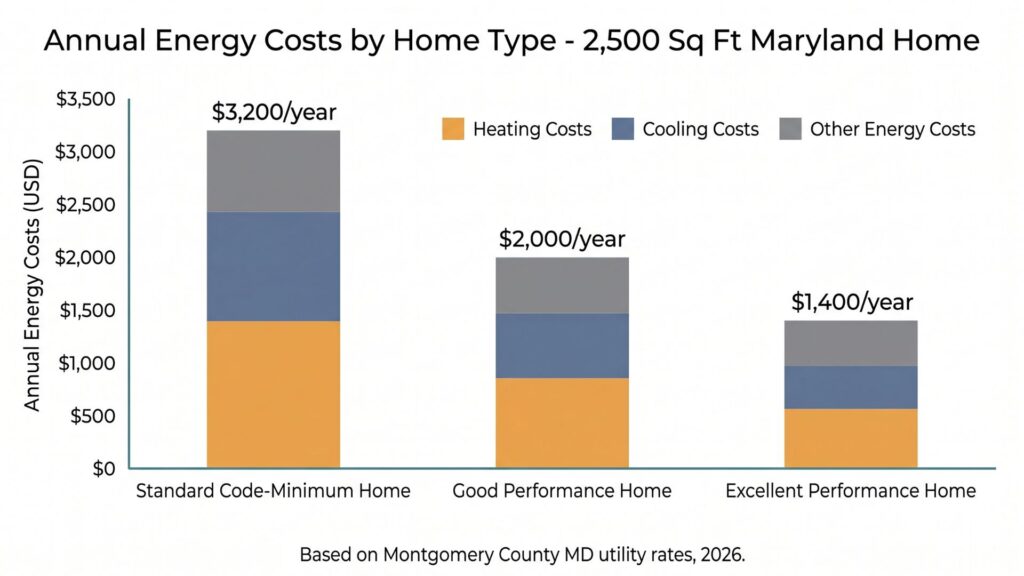
Energy efficient homes save money by reducing heating and cooling costs 25-40%, lowering maintenance expenses through better durability, and increasing resale value. ENERGY STAR certified homes save homeowners an average of $200-$400 annually in utility costs compared to code-built homes, with the savings increasing as energy prices rise. In Maryland’s climate with hot, humid summers and cold winters, efficient homes maintain comfort while using significantly less energy year-round.
The math is straightforward. A 2,500 square foot code-minimum home in Montgomery County might cost $2,400-$3,200 annually to heat and cool. A high-performance version of the same house drops that to $1,500-$2,000.
The $800-$1,200 annual savings compounds over time. Across 20 years of ownership, that’s $16,000-$24,000 in utility cost avoidance. Factor in likely energy price increases and the savings grow.
But the financial case goes beyond utility bills. High-performance homes have better indoor air quality because they include controlled ventilation instead of relying on random leakage. They’re more comfortable because surface temperatures stay more consistent. They’re more durable because the envelope manages moisture correctly.
Where the Savings Come From
Heating and cooling account for roughly 50% of residential energy use. That’s the biggest target for improvement.
Air sealing alone can reduce heating and cooling costs by 15-20% if infiltration is the main issue. Adding continuous exterior insulation on top of cavity insulation cuts thermal bridging and can save another 10-15%. High-performance windows prevent heat loss in winter and heat gain in summer, saving 5-10% depending on what you’re replacing.
Properly sized HVAC equipment matters more than efficiency ratings. An oversized system short-cycles, never reaching peak efficiency, and fails to dehumidify properly. A correctly sized system runs longer cycles, hits its efficiency targets, and maintains better humidity control.
We run Manual J load calculations on every project. It takes a few hours and costs nothing compared to installing the wrong equipment. Most tract builders size HVAC from square footage tables. That’s fast but inaccurate because it ignores actual heat loss and gain through the specific envelope you built.
Building science isn’t expensive. It’s intentional. Most of the techniques that create high-performance homes cost the same as standard construction when designed correctly from the start. See How We Build Custom Homes →
What Are the Key Features of Energy Efficient Homes?
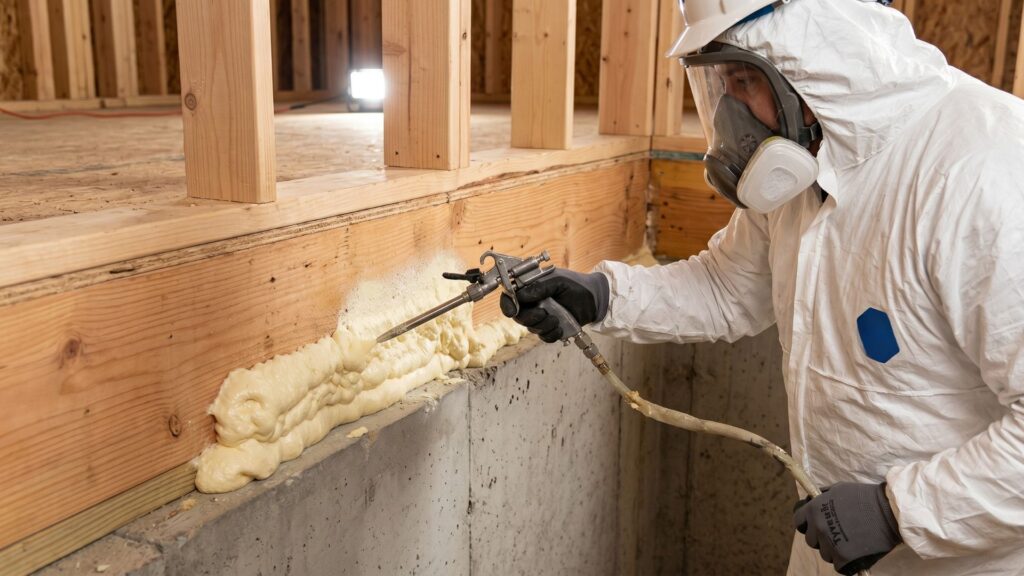
Key features of energy efficient homes include continuous air barriers, high R-value insulation without thermal breaks, high-performance windows and doors, properly sized and designed HVAC systems, and controlled mechanical ventilation. These elements work as a system: air sealing reduces heating and cooling load, allowing smaller equipment that’s sized accurately through Manual J calculations. Homes incorporating these features use 20-30% less energy than standard new construction.
Let’s walk through what actually matters, in order of impact.
Airtight Construction
Target: 3 ACH50 or lower on a blower door test. Code allows 5 ACH50 in Maryland. Better builders hit 2-2.5 ACH50. Passive House projects target 0.6 ACH50.
ACH50 measures air changes per hour at 50 pascals of pressure. It tells you how leaky the house is. Lower is better.
Getting to 3 ACH50 or below requires attention at every penetration. We seal the band joist with spray foam. We use airtight electrical boxes or seal standard boxes with caulk. We detail window rough openings with flashing tape, not just caulk. We seal top plates before drywall goes up.
These details take time but not expensive materials. A few cases of caulk, some cans of spray foam, attention to sequencing. The payoff is a house that doesn’t leak conditioned air.
Continuous Insulation and Thermal Bridging
Cavity insulation alone isn’t enough. Studs, plates, and headers create thermal bridges where heat flows through the framing instead of the insulation.
Continuous exterior insulation breaks that bridge. Two inches of rigid foam or mineral wool over the sheathing, detailed with taped seams, eliminates most thermal bridging and moves the dew point outside the structural cavity.
This approach costs more than cavity-only insulation but the performance gain is significant. Walls that test at R-21 cavity-only perform closer to R-15 effective once you account for framing. Add continuous exterior insulation and you’re at R-28-30 effective.
The same principle applies to the roof and foundation. Insulate over the roof deck, not just between rafters. Insulate the exterior of basement walls, not just between studs.
High-Performance Windows
Windows are the weakest link in most thermal envelopes. Single-pane is terrible. Standard double-pane is adequate. High-performance double-pane or triple-pane is the target for new construction.
Look for U-factors of 0.25 or lower and Solar Heat Gain Coefficients appropriate for your climate. In Maryland, you want windows that block summer heat gain without sacrificing winter solar gain.
Quality installation matters as much as the window itself. We flash rough openings with liquid-applied membranes or flexible flashing tape, integrate the window into the air barrier, and insulate around the frame. A $600 window installed poorly performs worse than a $400 window installed correctly.
HVAC Design and Sizing
This is where most builders cut corners without realizing it.
Proper HVAC design starts with Manual J load calculations based on the actual envelope you built. Not square footage rules of thumb. Not “what the last house needed.” Actual heat loss and gain through your specific walls, roof, windows, and foundation.
Once you know the load, you size equipment in Manual S and design ductwork in Manual D. The entire system needs to be engineered, not guessed.
For high-performance homes in Maryland, we’re increasingly spec’ing cold-climate heat pumps as the primary heating source. They’re more efficient than gas furnaces, they provide cooling, and they work down to -10°F or lower with newer models.
If the house is tight enough and well-insulated enough, ductless mini-splits become viable. We’ve done several projects where the heating and cooling load dropped low enough that ducted central systems were overkill.
Mechanical Ventilation
Tight homes need controlled fresh air. You can’t rely on leakage anymore.
Energy Recovery Ventilators (ERVs) or Heat Recovery Ventilators (HRVs) bring in fresh outdoor air while recovering heat and moisture from exhaust air. In summer, the ERV pre-cools incoming air using the cooler exhaust air. In winter, it pre-heats incoming air.
This maintains indoor air quality without the energy penalty of just opening a window.
We typically spec an ERV integrated with the HVAC system, running continuously at low speed. This provides background ventilation plus boost modes for high-occupancy periods.
Cost: $1,500-$3,000 installed. Operating cost: minimal because you’re recovering most of the energy that would otherwise be lost with exhaust-only ventilation.
Most builders optimize for first cost. We optimize for lifecycle value. The decisions you make during construction determine energy costs for the next 30 years. Learn About Our Process →
Do Energy Efficient Homes Need Special Maintenance?
Energy efficient homes require similar maintenance to standard homes but demand more attention to HVAC filters and ventilation system upkeep. ERV/HRV filters should be cleaned or replaced every 3-6 months, and heat pump systems need annual professional servicing. The U.S. Department of Energy notes that proper maintenance preserves efficiency gains, while neglect can reduce system performance by 15-25%. Most maintenance is straightforward and costs less than $200 annually beyond standard HVAC service.
The mechanical systems are more sophisticated, so they need proper care.
ERVs have filters that need cleaning. Most have washable filters you rinse every 3-6 months. Some have replaceable filters that cost $20-$40.
Heat pumps need annual service just like any HVAC equipment. Clean coils, check refrigerant levels, verify defrost cycle operation. Standard stuff for any HVAC tech who works on heat pumps regularly.
Beyond that, energy efficient homes are easier to maintain than leaky homes. Better moisture management means less risk of mold and rot. Better air sealing means less dust infiltration. Better insulation means more consistent temperatures and less stress on equipment.
The building envelope itself requires no special maintenance. Insulation doesn’t wear out. Air barriers don’t need servicing. Windows need the same cleaning as any window.
What’s the Difference Between Energy Efficient and Net Zero Homes?
Energy efficient homes use significantly less energy than standard construction, while net zero homes produce as much energy as they consume over a year through on-site renewable generation. Energy efficient homes in Montgomery County typically use 40-60% less energy than code-minimum homes without renewable energy systems. Net zero homes combine maximum efficiency with solar panels or other renewables to achieve net zero annual energy consumption, but the efficiency measures must come first to make net zero economically feasible.
You can’t solar-panel your way out of a leaky house.
Net zero starts with an efficient envelope. If you’re losing heat through air leakage and thermal bridging, you’ll need a massive solar array to offset that waste. Build tight and well-insulated first, then add renewables.
Most of our high-performance homes could reach net zero with an 8-12 kW solar array. That’s $16,000-$30,000 after federal tax credits. It’s a realistic addition, not a moonshot.
But we don’t push net zero on every client because it’s not always the right financial decision. If you’re planning to move in 7-10 years, the solar payback might not pencil out. If your lot has poor solar exposure, generation won’t meet expectations.
Energy efficiency makes sense for everyone because the payback is fast and the benefits are immediate. Net zero makes sense for clients with long time horizons, good solar exposure, and a desire to eliminate energy bills entirely.
Are Energy Efficient Homes Worth It in Maryland?
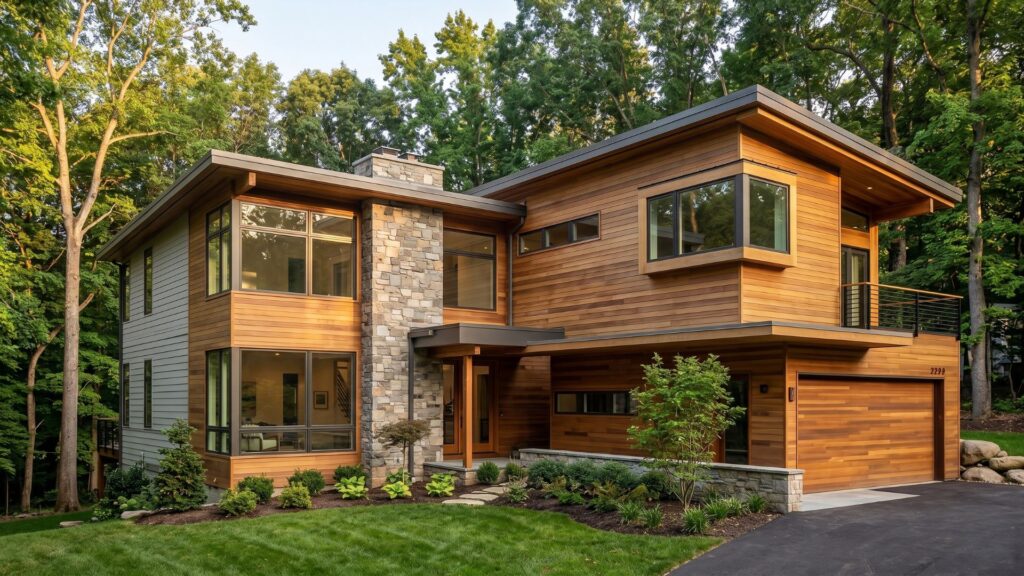
Energy efficient homes are worth it in Maryland because the state’s climate requires both heating and cooling, amplifying the savings from better envelopes and efficient HVAC systems. Maryland’s 2026 energy costs average $976-$1,162 for winter heating alone according to the National Energy Assistance Directors Association, making efficiency improvements particularly valuable. Montgomery County’s energy costs run higher than state averages, and efficient homes in our area save $800-$1,400 annually compared to code-minimum construction.
Maryland sits in a challenging climate zone. Summers are hot and humid, requiring significant cooling. Winters are cold enough to require real heating.
You’re running HVAC systems 8-10 months per year. Every percentage point of efficiency improvement compounds across both heating and cooling seasons.
In Minnesota, efficiency mostly matters for heating. In Florida, mostly cooling. In Maryland, it matters for both.
The other factor: Maryland energy codes are decent but not aggressive. The 2021 IECC with state amendments is better than what was required 10 years ago, but it’s not pushing builders toward high performance. You have to choose to build better.
Most production builders don’t. They build to code because that’s what passes inspection and keeps costs predictable.
If you’re building custom, you have the opportunity to build better. The incremental cost is small relative to the total project budget, and the performance difference is substantial.
We’ve built homes in Montgomery County that use 60% less energy than the code-minimum houses going up next door. Same square footage, same floor plan, different attention to building science.
That difference shows up every month in utility bills and every day in comfort.
Wondering if a custom home fits your family’s needs and timeline? Energy efficiency is just one piece of the puzzle. The real question is whether custom building aligns with how you want to live, what you value, and where you’re headed. Explore If Building Is Right for You →
How to Choose an Energy Efficient Home Builder in Maryland
Choose an energy efficient home builder in Maryland by asking about blower door testing, Manual J load calculations, continuous insulation strategies, and HVAC design process. Builders who discuss air sealing targets, thermal bridging, and ERV integration understand building science. Builders who size HVAC from square footage or skip blower door testing don’t. Request references from recent clients and ask about actual utility bills compared to projections.
The questions you ask reveal whether a builder thinks about performance or just checks code boxes.
Ask them to explain their air sealing strategy. If they shrug and say “we meet code,” they’re building to 5 ACH50. That’s adequate but not impressive. If they talk about target ACH50, specific sealing details, and blower door testing schedules, they’re paying attention to performance.
Ask how they size HVAC equipment. If the answer is “square footage” or “what the last house needed,” walk away. If the answer is “Manual J based on the actual envelope,” you’re talking to someone who understands load calculations.
Ask about continuous insulation. If they only insulate cavities, you’re getting code-minimum thermal performance. If they talk about exterior insulation or insulated sheathing, they’re addressing thermal bridging.
Ask about ventilation strategy. If the answer is “the house breathes naturally,” they’re relying on leakage. If the answer is “we integrate an ERV with the HVAC system,” they understand that tight homes need controlled fresh air.
Ask to see recent utility bills from past clients. Energy modeling is great, but actual performance data is better. Builders confident in their work will connect you with homeowners who can share real utility costs.
The builders who answer these questions specifically and confidently are the ones who actually build high-performance homes. The ones who deflect or get defensive don’t.
| Feature | Code-Minimum Home | High-Performance Home | Impact on Annual Energy Cost |
|---|---|---|---|
| Air Sealing | 5 ACH50 (code minimum) | 2.5 ACH50 or lower | 15-20% savings |
| Wall Insulation | R-20 cavity only | R-20 cavity + R-10 continuous | 10-15% savings |
| Window Performance | U-0.32 standard double-pane | U-0.22 high-performance | 5-10% savings |
| HVAC Sizing | Square footage estimate | Manual J calculation | 10-15% savings |
| Ventilation | Random leakage | ERV with heat recovery | 5-8% savings |
Note: Savings percentages are cumulative. A home incorporating all high-performance features typically achieves 40-60% total energy savings compared to code-minimum construction.
What Energy Efficient Features Add the Most Value?
Energy efficient features that add the most value are HVAC system upgrades, high-performance insulation and air sealing, and ENERGY STAR certified windows. Home value increases by $20 for every $1 saved on annual energy bills according to This Old House. HVAC improvements offer the largest impact, with efficient systems reducing energy consumption by 20-50%. In Montgomery County’s competitive real estate market, documented energy performance increasingly influences buyer decisions.
The features with the best return on investment are the ones that reduce operating costs most.
HVAC upgrades deliver the biggest bang. Replacing a 15-year-old 13 SEER air conditioner with an 18 SEER heat pump cuts cooling costs 30-40% and eliminates the gas furnace. The savings are immediate and substantial.
Air sealing and insulation improvements deliver excellent returns but they’re invisible to buyers. You need documentation: blower door test results, HERS ratings, utility bill comparisons. Without documentation, buyers just see “newer insulation” without understanding the performance benefit.
High-performance windows deliver good returns in Maryland because they address both heating and cooling. The comfort improvement is noticeable: rooms feel more consistent, less cold near windows in winter, less solar heat gain in summer.
Solar panels deliver mixed returns. They eliminate electric bills, but the payback depends heavily on system cost, utility rates, and financing. In Montgomery County with decent solar exposure, the payback is typically 7-12 years for cash purchases, longer if financed.
The highest-value improvements are often the least expensive: air sealing, duct sealing, attic insulation upgrades. These fix the biggest problems at reasonable cost.
Frequently Asked Questions
What is the most energy efficient type of home?
The most energy efficient type of home is a well-designed custom home optimized for the local climate with continuous air barriers, high R-value insulation, minimal thermal bridging, and properly sized mechanical systems. Passive House certified homes represent the highest performance standard, using 60-80% less energy than code-built homes, but any home designed with building science principles can achieve excellent efficiency. Structure type matters less than envelope performance and HVAC design.
How much does it cost to make a home energy efficient?
Making an existing home energy efficient costs $15,000-$50,000 for comprehensive improvements including air sealing, insulation upgrades, window replacement, and HVAC system improvements. Individual upgrades range from $1,000-$5,000 for air sealing and insulation to $8,000-$15,000 for HVAC replacement. New construction energy efficient upgrades add $10-$25 per square foot over code-minimum construction. ROI varies by improvement, with air sealing and insulation typically paying back in 5-8 years.
Are energy efficient homes harder to resell?
Energy efficient homes are easier to resell and command premium prices in most markets, particularly in areas with high energy costs like Montgomery County, Maryland. Homes with documented energy performance, HERS ratings, or ENERGY STAR certification sell 4-8% higher than comparable code-built homes according to real estate studies. Buyers increasingly prioritize lower operating costs, and energy efficiency data provides objective differentiation in competitive markets. Proper documentation is key to realizing the value premium.
Can old homes be made energy efficient?
Old homes can be made energy efficient through strategic retrofits focusing on air sealing, insulation, window upgrades, and HVAC improvements. The most cost-effective sequence addresses the biggest energy losses first: seal air leaks, add attic insulation, upgrade HVAC, then replace windows. Older homes with solid construction can achieve 30-50% energy savings through comprehensive retrofits. Historic homes require specialized approaches that preserve architectural character while improving performance.
What is a HERS rating and why does it matter?
A HERS (Home Energy Rating System) rating is a standardized score measuring home energy efficiency, where lower numbers indicate better performance. A typical resale home scores 130 (30% more energy use than a reference home), while new homes average 100. Energy efficient homes score 50-70, and net zero homes score 0 or below. HERS ratings provide objective comparison between homes and qualify homes for energy-efficient mortgages with better terms. Third-party raters verify the score through testing and inspection.
Do heat pumps work well in Maryland winters?
Modern cold-climate heat pumps work well in Maryland winters, maintaining full heating capacity down to 0-5°F and continuing to operate effectively to -10°F or lower. Heat pump technology has improved dramatically, and current-generation systems outperform older models that struggled in cold weather. In Montgomery County’s climate with average winter lows in the 20s-30s, heat pumps provide efficient heating throughout winter while offering cooling in summer, making them ideal for Maryland’s mixed climate requiring both heating and cooling.
How long do energy efficient home improvements last?
Energy efficient home improvements have different lifespans: insulation lasts 80-100+ years, air sealing 30-50+ years, high-performance windows 20-30 years, and HVAC systems 15-20 years. The building envelope improvements are essentially permanent once installed correctly, while mechanical equipment requires eventual replacement. This makes envelope improvements the best long-term investment, as they continue delivering savings long after mechanical equipment needs replacement. Proper installation and maintenance extend all improvement lifespans significantly.
What tax credits are available for energy efficient homes in 2026?
As of 2026, the federal Section 25C Energy Efficient Home Improvement Credit expired December 31, 2025. The 45L New Energy Efficient Home Tax Credit provides up to $5,000 for qualified new homes certified before July 1, 2026. Maryland state and local incentives vary by jurisdiction and utility provider, with some offering rebates of $500-$2,000 for qualifying heat pump installations. Check with Maryland Energy Administration and local utilities for current programs, as incentives change frequently and new legislation may restore expired federal credits.
Your Next Step: A Conversation About What Matters to You
Most builders talk about square footage and finishes.
We talk about how your house will perform for the next 30 years. What it costs to heat and cool. How comfortable you’ll be. Whether the air you breathe is actually clean.
Energy efficiency isn’t a checkbox. It’s a series of intentional decisions made during design and construction, when they cost the least and matter the most.
If you’re planning a custom home in Montgomery County, those decisions start now.
Ready to build a home that performs as well as it looks? Let’s talk about what matters to you: comfort, operating costs, indoor air quality, and building something that lasts. Schedule a Conversation →