What you need to know now about custom home builders in Maryland:
- A true custom home builder in Maryland constructs your home on land you own, from plans drawn specifically for your family. That is fundamentally different from a semi-custom builder.
- In Montgomery County, new home permits must clear three separate agencies (DPS, WSSC, and MNCPPC) before construction can begin. Total permit timelines typically run 10 to 16 weeks. Choosing a builder who knows the process is not optional.
- Building science determines how your home performs for the next 30 years. Maryland’s code minimum requires a blower door test at 3 ACH50. High-performance custom builders design to 1.5 or lower, and that gap shows up on every utility bill.
- Custom home starts nationally grew 3% in 2025 even as overall single-family starts fell more than 6%. In the DC metro, buyers are building because the resale market cannot deliver what they need.
Keep reading to understand how the process works, what separates a high-performance builder from everyone else in Maryland, and what to ask before you sign anything.
What Does a Custom Home Builder in Maryland Actually Do?
A custom home builder in Maryland manages every phase of constructing a home from raw land to final walkthrough, working from plans that were drawn specifically for you. There is no existing floor plan to select from, no predetermined exterior package, and no standard finish tiers. Every decision reflects your budget, your family’s routines, and how you want to live in the home.
This is distinct from semi-custom builders, who offer structural modifications within a fixed plan framework, and production builders, who build homes on their own lots from a catalog of designs. With a true custom builder, you own the land, you own the plans, and you control the outcome.
Ambition Custom Homes operates under that model across Montgomery County and the surrounding DC metro. We manage the full sequence: lot evaluation, architectural coordination, permitting through Montgomery County’s Department of Permitting Services, subcontractor selection, construction management, and final inspections.
Understanding what your builder actually controls changes every conversation you have with them. Explore how Ambition approaches each phase of your build from first call to move-in day. See Our Full Process: New Home Construction in Maryland
Where Does Ambition Custom Homes Build in Maryland?
Ambition builds custom homes throughout Montgomery County MD and the broader DC metro corridor. Our primary build areas include Potomac, Bethesda, Chevy Chase, North Bethesda, Rockville, Gaithersburg, Germantown, and select surrounding communities in the region.
Montgomery County is one of the most complex permitting jurisdictions in Maryland. New home permits require review and approval from three separate agencies: the Department of Permitting Services (DPS), WSSC (Washington Suburban Sanitary Commission), and MNCPPC (Maryland-National Capital Park and Planning Commission). DPS commits to completing its code review within four weeks. Total permit timelines, including outside agency reviews and any revisions, typically run 10 to 16 weeks for new construction.
That is not a warning. It is a reason to have a builder who knows the process.
We have worked through Montgomery County’s permitting system on projects across the county. We know which lots require variance submissions, which communities have deed restrictions that affect design, and how to prepare applications that clear DPS review on the first submission.
Where you build shapes what you can build. Before committing to a lot, see the full range of communities where Ambition has experience building in Maryland. Explore Where We Build
How Much Does It Cost to Build a Custom Home in Maryland?
Custom home construction in Maryland runs roughly $250 to $450 per square foot for the build itself, with Montgomery County and the DC-adjacent suburbs sitting at the higher end of that range due to labor costs, material logistics, and permitting complexity. High-performance builds with advanced mechanical systems, air sealing packages, and premium envelopes can run beyond $450 per square foot.
Those numbers cover construction only. Land, site preparation, permits, architectural and engineering fees, and carrying costs during construction are separate budget lines.
What Drives Cost Per Square Foot in Maryland
- Foundation type: Full basements are standard in Montgomery County and add cost compared to slab-on-grade construction common in other regions
- Lot conditions: Steep grades, rock, wetlands, or poor soil drainage add excavation and engineering expense before a single wall goes up
- Mechanical systems: A standard HVAC system and a heat pump with dedicated dehumidification and ERV (energy recovery ventilator) are not the same price point
- Envelope performance: Spray foam, ZIP system sheathing with taped joints, and triple-pane windows cost more than code-minimum assemblies, and they perform differently for 30 years
- Finish tier: Countertops, flooring, cabinetry, fixtures, and exterior cladding account for a larger share of total cost than most buyers expect during early planning
We cover Maryland-specific cost ranges, what they include, and how to budget accurately in our dedicated cost guide.
Want hard numbers before you commit to anything? Our Maryland cost-to-build guide breaks down what you actually pay in Montgomery County versus other parts of the state. Read the 2026 Maryland Cost-to-Build Guide
Maryland Builder Type Cost & Market Benchmarks (2026)
| Factor | True Custom Builder | Semi-Custom Builder | Production Builder |
|---|---|---|---|
| Typical price per sq ft (Montgomery County) | $300-$450+ | $225-$320 | $185-$260 |
| Typical base home size (sq ft) | 2,800-5,000+ | 2,200-3,800 | 1,600-3,200 |
| Architect fee (% of construction cost) | 8-15% (plans you own) | Included in base price (builder owns plans) | N/A (catalog plans) |
| Typical deposit to start design | 1-3% of estimated build cost | $5,000-$15,000 design center fee | $5,000-$10,000 lot hold fee |
| Change order markup range | 10-20% depending on contract | 15-25% (limited to allowed options) | Rarely permitted post-contract |
| Warranty structure | Negotiated per contract | Builder’s standard warranty (1/2/10) | Builder’s standard warranty (1/2/10) |
| Resale premium vs. comparable production home | 10-20% typical in Montgomery County | 5-12% | Baseline |
What Is the Ambition Custom Homes Building Process?
The Ambition process runs in two phases: a pre-construction phase where every decision is priced and documented before anything is built, and a construction phase where the approved plan is executed without budget surprises. The first phase is anchored by our Preliminary Building Agreement (PBA), which produces an accurate cost before you commit to full construction.
Phase 1: Pre-Construction
- Initial consultation: We review your lot, your program (what rooms you need and how they function), your budget, and your timeline. If your expectations and your budget are misaligned, we tell you in the first conversation.
- Architectural design: We coordinate with a licensed Maryland architect to develop plans that meet your program and perform within your budget. Design is iterative; most projects go through two to three rounds before plans are finalized.
- Preliminary Building Agreement: We produce a detailed line-item cost estimate from completed drawings. This is not a ballpark. It is the number your project will be built to, with transparent margins. Clients who skip this step with other builders are the ones who end up with change orders in the six figures.
- Permit submission: With finalized drawings, we prepare and submit permit applications to DPS, WSSC, and MNCPPC.
Phase 2: Construction
- Site preparation: Lot clearing, grading, and foundation excavation begin after permits are issued.
- Framing and envelope: Structural framing, sheathing, windows, and doors. Air sealing begins at this stage, not after drywall.
- Rough mechanical: HVAC, plumbing, and electrical rough-in, including any dedicated circuits for EV charging, solar prep, or smart home systems.
- Insulation and air sealing: We test mid-construction using a blower door before drywall goes up. If there are deficiencies, we fix them before they are hidden.
- Finishes: Drywall, paint, flooring, cabinetry, tile, and fixtures installed per the selections made during pre-construction.
- Final inspections and occupancy: County inspections, utility connections, punch list completion, and certificate of occupancy.
The emotional reality of building a custom home is harder than most people expect. We map the journey honestly, so you know what you are committing to. Understand the Client Emotional Journey and Our Process in Detail
Montgomery County MD New Home Permit Requirements
| Permit Type | Reviewing Agency | Timeline Commitment | Notes |
|---|---|---|---|
| Building Permit | Montgomery County DPS | 4-week code review | Requires MD-licensed architect plans and structural engineering |
| Water and Sewer | WSSC | Reviewed concurrently with DPS | Required for any connection to public water or sewer |
| Site and Grading | MNCPPC | Reviewed concurrently with DPS | Required for all new residential construction |
| Zoning/Variance | Board of Appeals | Variable (if required) | Only needed if proposed design conflicts with setback, lot coverage, or height limits |
| Electrical | DPS Residential Division | Part of building permit process | Separate inspection schedule required at rough-in and final |
| Mechanical / HVAC | DPS Residential Division | Part of building permit process | Includes duct leakage testing per Maryland IECC |
| New Home Builder License | DPS | Must be held prior to permit | Contractor must hold Montgomery County BC license |
How to Build a Custom Home in Maryland: The Steps in Order
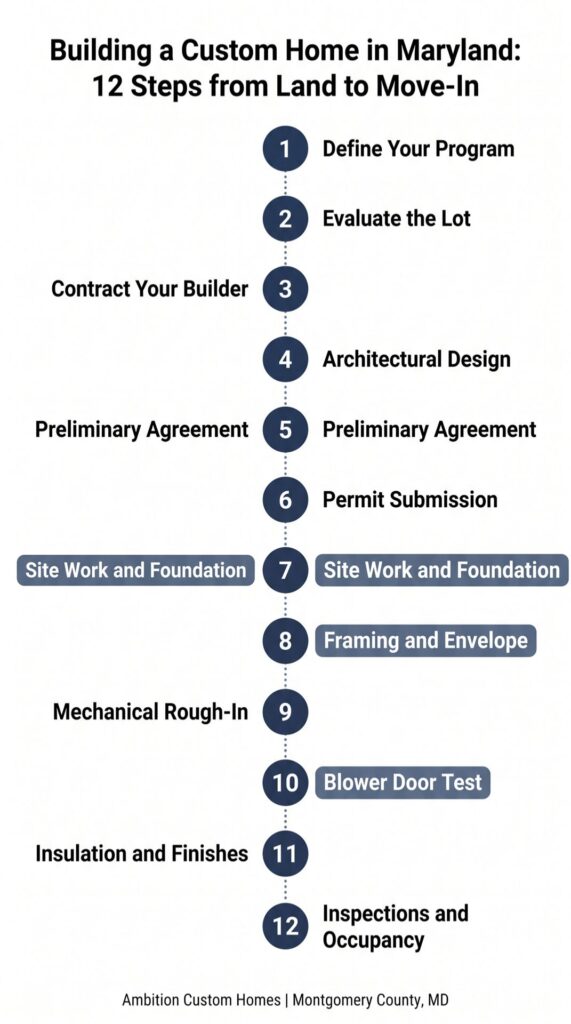
Building a custom home in Maryland follows a fixed sequence. Skipping or compressing any step creates problems downstream. Here is how the process runs from the first conversation to the day you move in.
Define your program
Before anything is drawn, document what you need: room count, must-have features, how the home needs to function for your household day-to-day. Program drives every decision that follows.
Evaluate your lot
If you have land, walk it with your builder before you commit to anything else. Confirm setbacks, drainage, soil conditions, utility connections, and any deed restrictions. If you do not have land yet, involve your builder in the search. A lot that cannot support your program at your budget is not the right lot.
Select and contract your builder
Verify the Montgomery County BC license and Maryland state builder registration. Review the pre-construction agreement structure. Understand how cost will be established and what controls budget growth.
Complete architectural design
Work with a licensed Maryland architect to develop floor plans, elevations, and construction documents. Expect two to three revision rounds before drawings are finalized. The plans you approve here are the plans your home is built from.
Complete the Preliminary Building Agreement
Your builder prices the completed drawings line by line. This is the step that converts a design into a real budget. Do not proceed to permit submission without it.
Submit permit applications
Your builder files with Montgomery County DPS, WSSC, and MNCPPC simultaneously. DPS commits to a four-week code review. Total permit issuance, including outside agency reviews, typically runs 10 to 16 weeks.
Break ground and complete site work
After permits are issued, the lot is cleared, graded, and excavated for foundation. In Montgomery County, most custom homes have full basements; foundation work includes waterproofing, drainage, and structural inspection before backfill.
Frame and close in the structure
Structural framing, roof sheathing, windows, and exterior doors. Air sealing begins at the framing stage, not after drywall. Penetrations, rim joists, and sheathing joints are addressed before they are covered.
Rough-in mechanical systems
HVAC, plumbing, and electrical rough-in. This is also when dedicated circuits for EV charging, solar conduit, and smart home infrastructure are installed. Inspections occur at rough-in before walls are closed.
Blower door test before drywall
This is the mid-construction airtightness test. It measures actual envelope performance while deficiencies can still be corrected. A builder who skips this step is guessing at performance.
Insulate, hang drywall, and begin finishes
Insulation is installed per the approved energy compliance path. Drywall follows. Then flooring, tile, cabinetry, countertops, paint, and fixtures are installed per the selections made during pre-construction.
Final inspections and occupancy
County inspectors review structural, electrical, mechanical, and energy compliance. Utility connections are finalized. The punch list is completed. A certificate of occupancy is issued.
Why Does Building Science Matter for a Maryland Custom Home?
Building science refers to the application of physics to how a home performs: how it manages heat flow, moisture, air movement, and mechanical loads. In Maryland’s mixed-humid climate, a home that is not designed to manage all four of those simultaneously will have comfort problems, durability problems, or both within five to ten years of occupancy.
This is where the difference between builders shows up most clearly.
Code-minimum construction in Maryland must pass a blower door test at 3 ACH50 (air changes per hour at 50 pascals of pressure difference). The average existing home tests around 7 ACH50 or higher. Passing at exactly 3 is different from designing to 1.5 or 1.0, which is what high-performance custom homes achieve.
Why ACH50 Numbers Matter to Your Monthly Bills
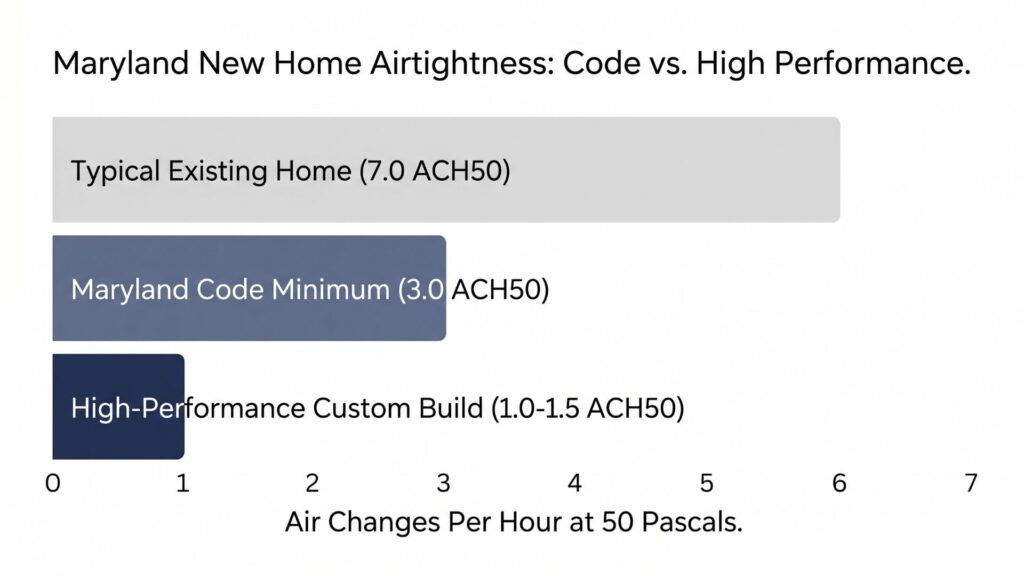
- A home at 3 ACH50 loses significantly more conditioned air through the building envelope than one at 1.5 ACH50
- Every cubic foot of conditioned air that escapes is replaced by unconditioned outdoor air, which your HVAC system then has to heat or cool
- Maryland summers run hot and humid. Unconditioned air infiltration carries both heat load and latent moisture load, stressing both the HVAC and the structure
If you want a standardized number to compare builders against each other, ask any Maryland builder you are evaluating for their typical HERS Index score. The HERS (Home Energy Rating System) score is the nationally recognized benchmark for measuring a home’s energy performance. A score of 100 is the 2006 reference point. A new home built to Maryland code minimums typically scores 60 to 80. A high-performance custom home built by a builder who actually targets airtightness can score below 50. That gap shows up on every utility bill for the next 30 years.
Dive deeper into what a high-performance Maryland home actually costs and saves long-term. Explore Our Energy Efficient Homes
What Makes a True Custom Home Different From a Semi-Custom or Production Build?
A true custom home is built to plans drawn specifically for your family, on land you own, with no preset floor plan constraining what is possible. Semi-custom builders modify existing plans within structural limits. Production builders build from a fixed catalog on their own lots and sell home and land as a package.
The distinction matters because buyers regularly discover the difference only after they have signed with a builder who uses the word “custom” loosely.
Side-by-Side Comparison
True Custom Builder:
- Blank-slate floor plan drawn around your program
- You own the land and the architectural plans
- Builder has no financial interest in the lot
- Material and subcontractor selections are open
- Cost is determined by your choices, not preset tiers
Semi-Custom Builder:
- Modified versions of existing floor plans
- Builder may own the lots in a planned development
- Structural changes limited to pre-approved options
- Finish selections drawn from a preset design center inventory
- Base price plus structured upgrade pricing
Production Builder:
- Fixed plans, no structural modifications
- Builder owns the land; you buy home and lot together
- Design center upgrades are the primary customization tool
- Faster build timeline because of standardization
- Lower entry price, narrower control over outcome
Most buyers in Montgomery County and Bethesda who contact Ambition have already had at least one conversation with a production or semi-custom builder. The comparison becomes clear quickly. When the floor plan has to change to accommodate how your family actually lives, and when a pre-set finish tier cannot get you to the kitchen you have been designing in your head for three years, a true custom build is the only path.
See the range of what Ambition has designed and built for Maryland clients before your consultation. Browse the Ambition Design Library
How Does the Design Process Work for a Maryland Custom Home?
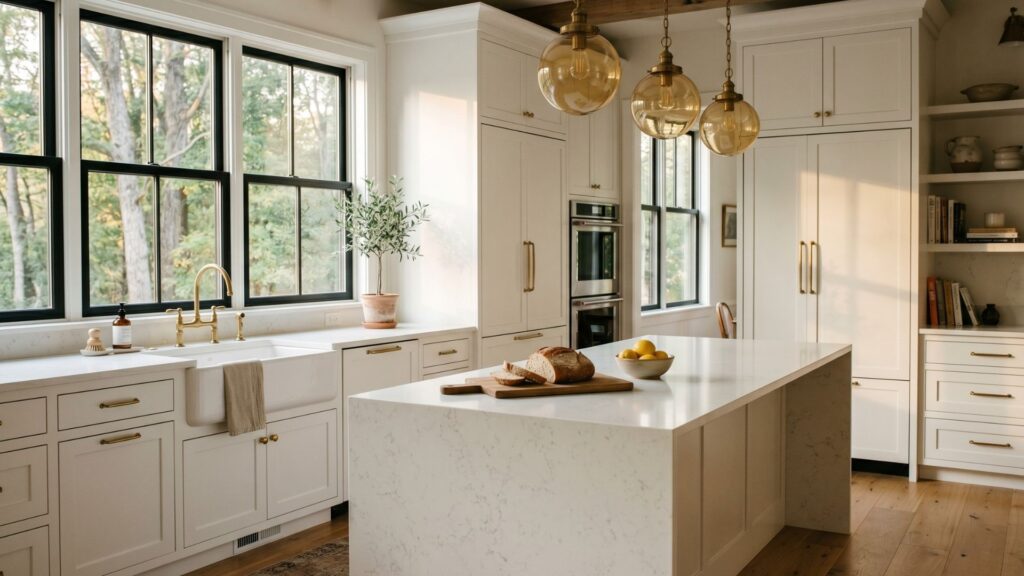
The design process at Ambition starts with program development: a structured conversation about how many people will live in the home, how you use space day-to-day, and which rooms matter most to you. Program comes before plan. Most builders do it the other way around.
From program, we coordinate with a licensed Maryland architect to develop concept drawings. Those drawings go through rounds of revision until the layout works. Then structural engineering is added. Then mechanical, electrical, and plumbing systems are roughed in on plan. Only when all of that is complete do we produce the Preliminary Building Agreement with a real cost.
What the Design Process Includes
- Program development: Room count, adjacencies, functional priorities, lifestyle inputs
- Conceptual drawings: Floor plan layouts for review and revision
- Design development: Finalized floor plans, elevation drawings, section cuts
- Specification development: Material and system selections that drive the line-item cost estimate
- Construction documents: Permit-ready drawings with all structural and engineering information
- Interior design coordination: Finish selections for flooring, tile, cabinetry, countertops, hardware, and lighting
What Should You Look for in a Maryland Custom Home Builder?
The most important thing to verify with any Maryland custom home builder is licensure. Builders working in Montgomery County must hold a Montgomery County New Home Builder’s (BC) license to pull permits. This is not optional and is not the same as a general state contractor license.
Beyond licensure, the questions that separate capable builders from problematic ones are mostly about transparency and process:
Questions Worth Asking Before You Sign
- Do you use a Preliminary Building Agreement or equivalent pre-construction cost process? If not, ask what prevents the budget from growing after you have committed.
- Who reviews my project for energy code compliance, and at what stage of construction?
- How do you handle subcontractor selection? Is your sub base consistent across projects?
- Can you show me the permit history for your last three projects in Montgomery County?
- What does your typical communication cadence look like during construction?
- How do you handle change orders, and what is your markup on changes?
We have a dedicated article on understanding custom home proposals and contracts on our site. If you are comparing multiple builders in Maryland, those are the documents where the real differences show up.
What the 2026 Maryland Market Looks Like
Custom home starts nationally grew 3% in 2025 to 186,000 homes, even as overall single-family starts fell more than 6%, according to NAHB’s Eye on Housing analysis published March 2026. The custom segment is less rate-sensitive than production building because most custom buyers are not financing the way a first-time buyer is.
The buyers who contact Ambition are typically not rate-sensitive. They are making a build decision because a $2.8 million existing home on a Potomac lot still has a kitchen from 2003 and a floor plan that puts the primary bedroom over the garage.
Custom homes, our process, and every community we build in: it is all here. Explore Ambition Custom Homes
Frequently Asked Questions: Custom Home Builders in Maryland
What happens if I find a lot in Montgomery County but it has wetlands on part of it?
Wetlands in Maryland are regulated at both the state and county level. If any portion of your lot falls within a wetland or 100-year floodplain buffer, your buildable area may be significantly smaller than the total lot size suggests. Montgomery County’s MNCPPC review will flag this, but the time to know is before you close on the land. We walk lots with buyers before purchase and have flagged drainage issues, easements, and wetland buffers that would have made the build far more expensive or impossible at the client’s desired program size.
Can I finance a custom home build the same way I would finance a production home purchase?
No. Custom home construction is financed with a construction loan, which is a short-term credit facility that funds the build in draws as work is completed. When the home is finished, it converts to a permanent mortgage. This is different from a conventional mortgage for a finished home. Construction loans require a detailed project budget (which is why the PBA matters for financing, not just planning), a signed builder contract, and in some cases, evidence that you own the lot free and clear or have the lot as collateral. We have a full article on custom home financing on our site and can refer clients to lenders with construction loan experience in the Maryland market.
What are the most common design mistakes Maryland custom home buyers make that cost them money later?
Three show up repeatedly in our experience. First: under-sizing the mechanical room and utility spaces when prioritizing living square footage, which limits the home’s ability to accommodate high-performance systems. Second: placing the primary suite directly above the garage in a Montgomery County climate without specifying appropriate insulation at the garage ceiling; comfort problems follow. Third: not thinking through circulation early enough. Where everyone walks to get from the garage to the kitchen at the end of a workday shapes whether a floor plan actually works for a family. These are the conversations that happen in program development, before a single line is drawn.
Does building a custom home in Maryland affect my property taxes differently than buying a production home?
Yes. In Maryland, new construction triggers a reassessment. For Montgomery County, the assessed value of a newly completed custom home is typically based on the cost of construction plus the land value, and property taxes are recalculated accordingly. The taxable assessment can jump significantly in the first year compared to what you paid for the lot alone. Budget for the post-completion tax bill, not just your carrying costs during construction.
What is the Maryland Homebuilder Registration Act and does it apply to my builder?
Maryland requires residential home builders to register with the Maryland Home Builder Registration Unit under the Maryland Department of Labor. This is separate from a general contractor license and separate from Montgomery County’s local BC license. A builder who is not registered with the state cannot legally contract to build a new home in Maryland. Before signing any agreement, ask for both the state registration number and the Montgomery County BC license number, and verify both are current.
How does Ambition handle subcontractors, and why does it matter for the quality of my home?
We work with a consistent base of subcontractors we have vetted across multiple projects in Montgomery County. That consistency matters because custom home quality depends heavily on how well the subs understand the standards we hold on airtightness, rough framing tolerances, and finish installation. A builder who puts each project out for competitive sub bidding gets a different crew on every job. We do not operate that way. Our framing crew knows that we blower-door test before drywall. That knowledge changes how carefully they approach air sealing at penetrations and rim joists.
Why Choose Ambition Custom Homes for Your Maryland Build
Most Maryland buyers who contact us have already spoken to two or three builders. They arrive with a spreadsheet, a lot of conflicting information, and a budget that may or may not match what they want to build.
The first thing we do is get honest about those three things together. Program, budget, land. If they align, we move forward. If they do not, we tell you before you spend a dollar on architectural drawings.
That is not how most builders operate. Most builders take your deposit and let the reality surface later, usually in the form of a change order after framing.
Ambition was built around Jason Dubin’s conviction that buyers in the DC metro deserve the same level of cost transparency and building science rigor that serious commercial construction demands. Our pre-construction process, our mid-construction testing, and our small client volume are all expressions of that.
We do not take on every project that comes through the door. We take on the ones we can build well.
If you are in the early stages of thinking about a Maryland custom home, the first conversation costs you nothing and tells you a great deal.
Ready to talk about your Maryland custom home project? Contact Ambition Custom Homes